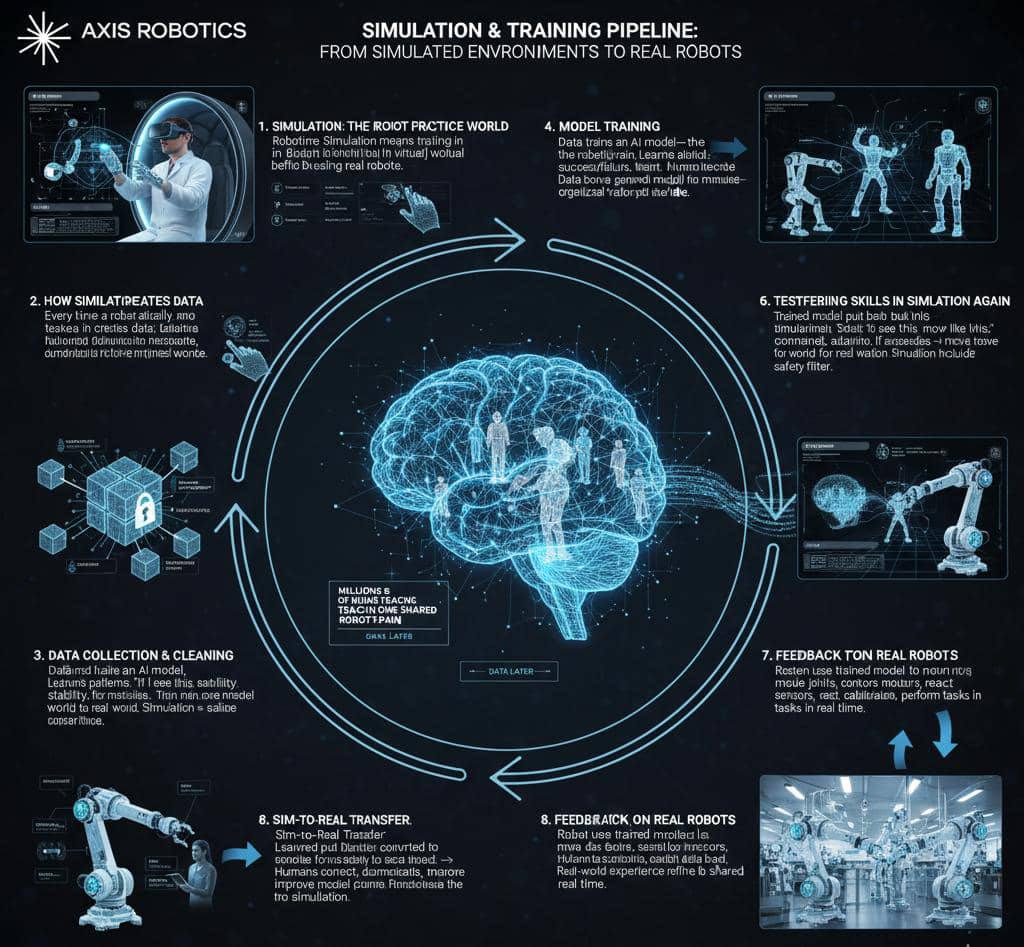
Simulation & Training Pipeline
From simulated environments to real robots.
AxisRobotics first teaches robots in a safe computer world, then turns those lessons into a brain, and finally lets real robots use that brain.
Simulation means creating a fake or virtual version of something real, so you can test, learn, or practice without doing it in real life.
Robotic simulation means training and testing robots in a virtual (computer) world before using real robots.
In this world:
- Robots exist as digital models
- Gravity works
- Objects have weight
- Robots can fail without breaking anything
Think of simulation as a video game for robots.
In simulation, robots:
- Practice moving arms
- Practice grabbing objects
- Practice balancing or walking
- Try the same task thousands of times
If the robot fails:
- Nothing breaks
- The task restarts
- Learning continues
This allows fast, cheap, and safe learning.
Every time a robot moves in simulation, it creates data.
This data includes:
- Where the robot was
- How fast it moved
- Which joints rotated
- What it touched
- Whether it succeeded or failed
Humans can also:
- Demonstrate correct movements
- Fix robot mistakes
- Guide the robot step by step
Every action becomes a lesson.
All generated data is:
- Collected automatically
- Cleaned (bad data removed)
- Labeled (success / failure)
AxisRobotics also:
- Records who contributed the data
- Stores it securely
- Uses blockchain to prove ownership and trust
Data becomes organized robot experience.
Now the data is used to train an AI model.
An AI model is the robot’s brain. It learns patterns like:
- When I see this object, move like this
- If I fail, adjust my grip
- This movement works better than that one
The model:
- Studies thousands of examples
- Learns from many humans
- Improves with each training round
This is learning by experience, just like humans.
Before touching real robots, the trained model is:
- Put back into simulation
- Tested again and again
- Checked for safety and stability
If the model:
- Makes mistakes: retrain it
- Acts unstable: fix it
- Succeeds: move forward
Simulation acts as a safety filter.
This is the most important step: how skills move from simulation to hardware.
The learned skills are:
- Converted into motor commands
- Adapted to real-world sensors
- Calibrated for real weight and friction
This process is often called: Sim-to-Real Transfer.
To make it work:
- Simulation includes randomness (noise)
- Robots train under many conditions
- Models learn to be flexible, not perfect
This helps robots survive the real world.
Now the robot uses the trained model to perform tasks in real time:
- Move its joints
- Control motors
- React to sensors
- Perform tasks in real time
Examples:
- Picking objects
- Placing items accurately
- Adjusting grip strength
- Avoiding mistakes
The robot is no longer guessing. It’s using learned intelligence.
Real robots are never perfect.
So AxisRobotics:
- Watches robot behavior
- Records errors and success
- Sends new data back to the system
Humans can:
- Correct wrong behavior
- Add new demonstrations
- Improve the model further
Real-world experience improves the simulation next time.
Here is the full pipeline in one flow:
Simulation → Data → Model Training → Simulation Testing → Real Robot → Feedback → Better Simulation → Smarter Model
This loop never stops. Each cycle improves robot skills, makes robots more general, and makes intelligence transferable across machines.
- Simulation = practice at home
- Data = memories
- Model = brain
- Real robot = real life
- Feedback = learning from mistakes
AxisRobotics is a system that lets robots practice safely, learn deeply, and act confidently in the real world.