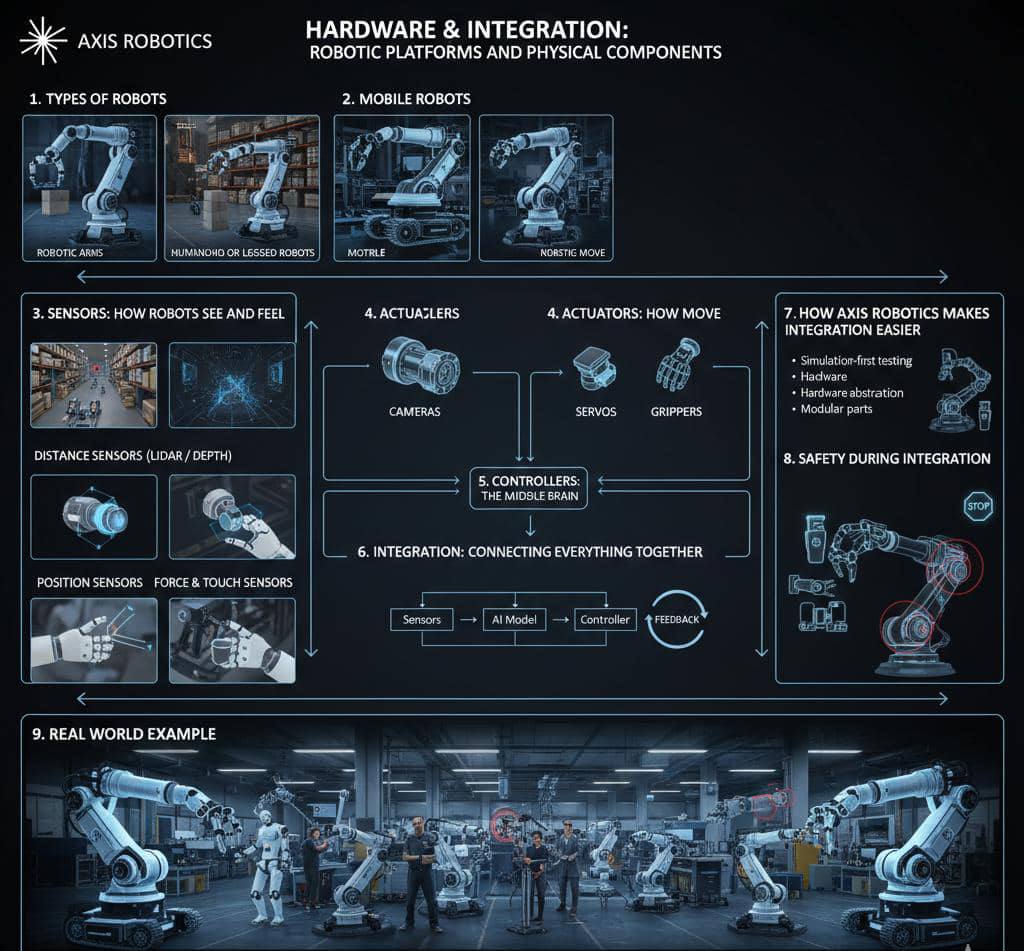
Hardware & Integration
Robotic platforms and physical components.
Hardware & integration is how AxisRobotics connects the robot’s body (motors, sensors, parts) to the robot’s brain (AI model) so it can move and react in the real world.
Hardware is the physical robot you can touch. This includes:
- Robot arms
- Wheels or legs
- Motors
- Cameras
- Sensors
- Controllers
- Power systems
Hardware is the robot’s body.
AxisRobotics is built to support many robot types, not just one. Common robot platforms include:
Used for picking and placing objects. This includes:
- Factory-style arms
- Educational arms
- Research arms
Examples of tasks:
- Grab a block
- Move an object
- Stack items
This includes:
- Robots with wheels
- Robots that move around spaces
- Delivery or inspection robots
Tasks:
- Navigate rooms
- Avoid obstacles
- Move from point A to B
This includes:
- Robots with legs
- Balance and walking tasks
- More complex movement
Tasks:
- Standing
- Walking
- Adjusting balance
AxisRobotics focuses on general intelligence, so the same learning system can work across many robot bodies.
Sensors are the robot’s senses. They tell the robot what is happening around it. Common sensors used:
- Let robots see objects
- Detect shapes, colors, and positions
- Measure how far objects are
- Help avoid collisions
- Tell robots where their joints are
- Track angles and movement
- Detect pressure
- Help robots grip objects gently
Sensors answer the question: What is happening right now?
Actuators are the robot’s muscles. They turn decisions into motion. Common actuators:
- Rotate joints
- Move arms or wheels
- Precise movement control
- Used in joints and grippers
- Robot hands
- Open and close to grab objects
Actuators answer the question: How do I move?
Controllers sit between the AI brain and the hardware. They:
- Receive commands from the AI model
- Translate them into motor signals
- Ensure movements are safe and smooth
Think of controllers as translators between thinking and moving.
Without controllers, motors would move wildly and robots could damage themselves.
Integration is making all parts work as one system. Integration steps (simple flow):
Sensors → AI Model → Controller → Actuators
- Sensors collect information
- AI model decides what to do
- Controller converts decisions to signals
- Motors move the robot
This loop runs many times every second.
AxisRobotics is designed to be hardware friendly. It supports:
- Simulation-first testing
- Hardware abstraction (same brain, different bodies)
- Modular robot parts
- Standard robotics software tools
This means:
- You can swap robot arms
- Use different sensors
- Upgrade motors
- Keep the same AI brain
Intelligence is not locked to one robot.
AxisRobotics emphasizes safety before real movement:
- Models are tested in simulation
- Movement limits are set
- Force and speed are controlled
If something goes wrong:
- Robot stops
- Data is recorded
- Model is improved
Safety first, always.
Imagine a robot arm picking up a cup:
- Camera sees the cup (sensor)
- AI decides how to reach it (model)
- Controller plans movement
- Motors move the arm (actuators)
- Gripper closes gently
- Sensors confirm success
All of this happens in milliseconds.
Think of a human compared to a robot:
- Eyes = Cameras
- Skin = Touch sensors
- Muscles = Motors
- Brain = AI model
- Nerves = Controllers
AxisRobotics connects all these parts so robots can act like intelligent beings, not just machines.